Leslie’s friends and frequent users of this Blog might like to know of the following developments concerning the archiving of Leslie’s written work and of her gardens.
THE COLLECTED PAPERS OF LESLIE LAND
Leslie’s papers are being preserved at The Schlesinger Library, Radcliffe Institute for Advanced Study, Harvard University. https://www.radcliffe.harvard.edu/schlesinger-library The Schlesinger houses the collections Culinary Historians as well as of noted American Women. Here Leslie will take her place alongside Julia Child, Betty Freidan and others. From their records, it appears to me that the Library became interested in obtaining Leslie’s papers as far back as 1985.
In today’s age the term “papers” designates far more than what we assumed in times past. As many writers of her age, Leslie’s words and ideas were recorded by an increasingly complex array of modalities from handwritten entries on scraps of paper, in notebooks and journals, typewritten script, through iteration upon iteration of word-processing machines and digitally processed computer files with differing formats and storage systems, to various email, audio video, social media and associated interfacing programs. Even the website you have accessed here and on which you are reading these words has been ‘captured’ by the Library.
Being an inveterate collector, record keeper and historian, as you might imagine, Leslie saved everything.
Over the past six years, from our two houses, two barns and two sheds, I have been prying these documents from the shelfs, closets, drawers and desks, annotating what I could when I thought it appropriate, and sending the collection off to the Schlesinger. Technologically savvy Librarians from area Colleges helped in condensing the digital records from various computers and hard drives. To date, 27 boxes have been sent off. The annotated inventory record itself runs to 37 pages. For me, it was a help to have previously worked as a research assistant at The University of Chicago Law School Library when it came to making decisions as to what might be worth saving or annotating.
Additional material may be added as it becomes available. If you have personal correspondence with Leslie or other material which you would like to add please contact Kathryn Allamong Jacob, Curator of Manuscripts at the Library.
At the Schlesinger, only a small part of the collected papers has as yet been digitized and catalogued. Those currently available can be found via their HOLIS Search at https://hollis.harvard.edu/primo-explore/search?query=any,contains,Leslie%20Land&tab=everything&search_scope=everything&vid=HVD2&lang=en_US&offset=0
LESLIE’S GARDENS
Leslie’s Gardens have been modified and maintained. In both the New York and Maine Gardens, the emphasis has moved from select plots of edibles tested for their hardiness and flavor to perennial plantings with more a sculptural aspect.
Maine, in particular, where excellent organic produce is readily available, has seen the most obvious changes. Following the trends and plans that Leslie initiated prior to her death, the dominant theme here has been to focus on perennials:

Celia and Ursula surrounded by perennial plantings in the Upper Garden
Everywhere there is more open space, the vistas are longer, more expansive, the view towards the water has opened up.

The Lower Perennial Garden, once vegetables, with vistas toward the St. Georges tidal river.
In New York the emphasis has been on flowers.

New York side garden with Eucomis, canna, and goldenrod set amongst perennial shrubs.
At times a Mother/Daughter team has run the main gardens here for their Herb and Flower Business. The soil continues to be amended annually via organic sustainable techniques and produces far beyond the expectations of first time users of this garden. Once a railroad bed, the soil is now double dug deep and of a rich loamy composition.
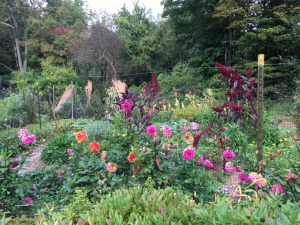
The main New York Garden, south plot. Once a Railroad, the soil is now deep dark and productive, overflowing with flowers.
The one area which I have yet to resolve is the disposition of Leslie’s private Library. Stretching over 100 linear feet, her collection of agricultural, culinary, and related references represent a highly curated selection which informed her work and life. I am loath to break it up thinking, as I do, that the integrity of the collection is worth more than the sum of its parts, but to date I have not found a home for this resource. I would welcome any suggestions you might have. This website will continue to be maintained.
On a related note, you might wish to know that Lois is doing well and continues to garner wide recognition for her painting. Other artists continue to come by to paint and play in the gardens, and Kristi continues on as my master gardener, knowing much more than I, and retaining a clear memory of what Leslie intended, reprimanding me when I deviate too far from those plans.
As for me, the gardens, the writings, the lives together remain as a clear message and living testament, even as I move on, to what I learned from Leslie: One’s life is One’s work. It is all there is, the sum and substance of our time here on earth. We plant the seeds, separate from the sprout the weeds which rob from the promise, cut away the disease which eats at the heart, where possible prune away the distracting, the disturbing, the untruthful. “Edit,” as she would say. What remains is the essence; the essence of the fruit, of the life – the sole purpose of which, once savored, is to be returned again to the soil as compost for the future. It is a cycle repeated as time itself repeats, for time reveals us all as compost; the green fuse, the fruit forced firm and full, the memories fermenting in the firmament.
Who tends this space?
The wind blows, the bough bends,
Ashes lie in the garden.
Without discrimination,
The summer’s sun pushes both
rose and rust to ruination.
Bill Bakaitis December 2019
 Leslie’s obituary in the New York Times was written by her longtime friend in the publishing world, Denise Martin, with assistance by Charles Klaveness, her favorite editor at the Times and can be found here »
The obituary prepared for the Camden Herald in Maine was written by Nancy Harmon Jenkins with assistance from Sandy Oliver, two thirds of The Penobscot Bay Lady food Writers Association and can be viewed here »
At the time of this writing two articles of her passing have been published:
Here »
and here »
At least one other is being prepared for the Camden Herald/Village Soup.
In response to the Press Herald blog post, the root above, I responded with the following:
Indeed Leslie did live more in a day than even I, her husband, was aware. Together, for a quarter century, we shared the daily rituals of food, gardening, mushrooming, philosophy, politics, taxonomy, struggles with the various illnesses which have plagued our bees, our tomatoes, and crops in general. And yet, she continually surprised even me. Life with her was profoundly rich.
She was luxuriant, perhaps even extravagant with her approach to both food and gardening. She always wanted enough in the garden and refrigerator so that she could experiment, plan, compare and develop beyond the ordinary. Just as Americans in general have the most expensive pee in the world, thanks to our copious vitamin intake, I think Leslie may have had the most expensive compost.
There was an abundance to her life which filled our houses and lives to the fullest. In our New York (winter) home we have two freezers, two refrigerators, a cold room, greenhouse and several pantries which overflow with food that she has gathered from the garden, collected from the forest and field, or purchased from local and exotic purveyors. These ingredients are, of course, the raw materials and colors from which she created the ever increasing richness of her preparations. And yet, at base, it was always fresh, pure, and simply satisfying. I believe it was Edgar Alan Bean, another food writer who years ago described Leslie as having ‘perfect taste’, comparing her to musicians who had ‘perfect pitch’.
Even now that she has passed our houses and gardens overflow with her presence. In one distant corner of our NY garden , for example, are three tomato plants grown from seed which for the past three years has been collected and grown out from the best of the ‘long keeper’s’ of one particular and tasty variety. This is but one of the 30 or more varieties of tomatoes she grows and tests every year, both in New York’s Hudson Valley and Coastal Maine – so that she can compare the interactions of micro-climate and variety on taste, texture, and overall plant health.
As it was with food and gardening, Leslie applied the same lawyerly analytics and tender sensibilities to everything she approached and, as Sharon so accurately captured she filled the pages of her books and blog with wit, wisdom and insight. She was always a hard act to follow. Bright, honest, caring, loyal, the brightest person I have ever met and best friend one could ever have.
She will be missed by many.
 This Website and Blog will be maintained for the resource that Leslie intended it to be. In time I will attempt in some minimal way to learn enough to ‘manage’ it, although I will never know enough to do it with the richness you have come to expect.
Between here and there, however, there are her gardens in the Hudson Valley and Coastal Maine to see through to harvest; weeds to be pulled, tomatoes picked, savored and processed, corn to be guarded, flowers dead-headed, mushrooms gathered, records kept.
With her passing, the words of the poet W.S. Merwin* flood my being:
Your absence has gone through me
Like thread through a needle.
Everything I do is stitched with its color.
* Separation
— Bill Bakaitis August 18, 2013

‘Hally Jolivette’ flowering cherry. The deep pink buds open pure white in some flowers, pink throated in others, making it especially striking up close. The bloom can go on for two weeks or a bit more, if the weather is right.
As you may have noticed, we’re deep in the season for going on about the Lovliest of Trees, even though these days most flowering cherries appear to be hung with something that looks more like cotton candy than the snow that so moved Housman. Our friend Eric is not immune, and not surprisingly, he has a favorite.
Read More…

Sunshine cookies, my new name for Figolli, with semi-traditional Figolli decoration. (It’s semi-traditional because there should be a foil-wrapped chocolate egg somewhere on each cookie. I compromised with (one) golden Jordan almond.
Why sunshine? Because they’re full of citrus zest – lemon, orange and lime – and they have a rich almond filling spiked with orange flower water. These are all things that say “Mediterranean” to me, plus Figolli are from Malta.
And why ignore their perfectly good name to create another one? Because “Figolli” is totally married to Easter and I think the cookies are way too good to make only once a year.
Read More…
This post was inspired by Cindy Martin, who found the vintage baking pan story and wrote to ask what popovers were and whether I had a recipe.
How could there be anyone who doesn’t know what a popover is? thought I.
Then I realized – but of course! Popover innocence would be almost a given if no one in your family baked. These addictive quick breads are easy to make but impossible to manufacture commercially. They don’t just have to be oven-fresh to be any good, they pretty much have to be oven fresh to exist whatsoever. 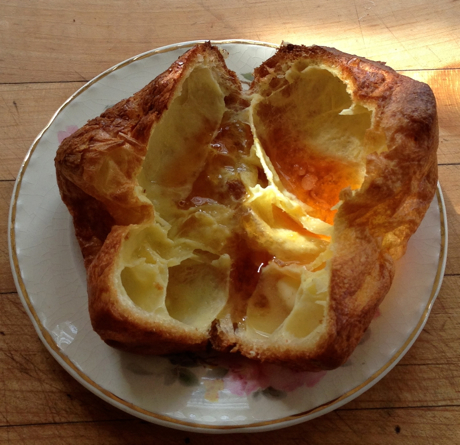
- A popover, split, buttered, drizzled with syrup from candied pineapple. Honey and jam are more common sweet additions, but it’s hard to go wrong. Alternatively, you can channel ladies’ lunch circa 1950 and fill them with creamed chicken or tuna salad.
Having grown up making and eating popovers without realizing there was mythology attached, I got ready to answer Cindy’s question by simply writing down the formula I learned when I was about thirteen. But then, just to be sure I hadn’t missed anything, I undertook some research.
To my surprise – I’m often the last to realize these things – popovers have a reputation for being difficult. Everywhere I looked, in print and online, recipes were full of warnings, injunctions, caveats and ironclad rules, many of them contradictory: Use a hot oven; use a cold oven; beat the batter thoroughly; don’t over mix the batter; let the batter rest; use the batter right away; be sure you develop the gluten; be sure you don’t develop the gluten. Oy.
Here’s what: advice about popovers probably offers the highest ratio of balderdash to useful information I’ve ever seen for a formula that has only 5 ingredients.
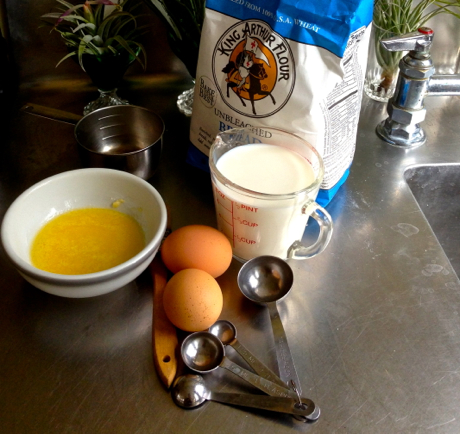
Ingredients for popovers – I use bread flour but it’s not essential. I forgot to show the salt – please don’t forget to use some.
Read More…

Behold our beloved old toaster.
“Beloved.” Not an adjective I’d have used until about a week ago, when I started trying to find another one like it.
As even the blurry photo shows, age has cracked the top and dulled the plastic, so although it’s still fully functional it isn’t exactly a thing of beauty. Never was. But it’s not exactly ugly, either. And more to the point, it’s very well designed.
Read More…
In spite of what some people say. I’ve done it before and am about (with luck) to do it again, even though I keep swearing up and down I’ve had it with plants that have to be brought in for the winter.
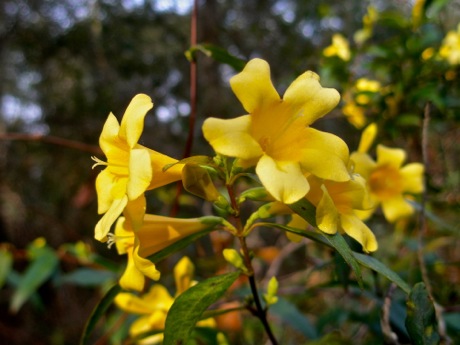
Carolina jessamine, Gelsemium sempervirens. Not really a jasmine at all. But it IS the Southern fragrance that inspired my current bout of jasmine lust.
Read More…
or more accurately, false alert.
My struggles to learn how to post from my ipad seem to have resulted in the publication of a test post I did not intend to publish. So I unpublished it. Unfortunately, not before the word went out there was something new to enjoy. Please stay tuned for an exciting report from zone I think it must be 10 down here.

here are some lovely bromeliads I’m struggling to custom size to our accustomed size.
That’s “funny” as in “peculiar.” Found it years ago in a junk shop, when I still had time/inclination to rummage about in the old postcards. The writing side is blank. There is a box for the stamp: One Cent Domestic, Two Cents Foreign.
The sentiment in the lower right – difficult to photograph – is “I Do Love Violets; They Tell The History Of Woman’s Love.”

I can only suppose the purple flowers are violets, although the artist appears to have taken considerable liberties. The white ones are clearly lilies of the valley.
Needless to say, there is no WAY I’d ever give it to anyone, including my adored husband (who, in any case, fails to appreciate this sort of thing for the wonderfulness it is).
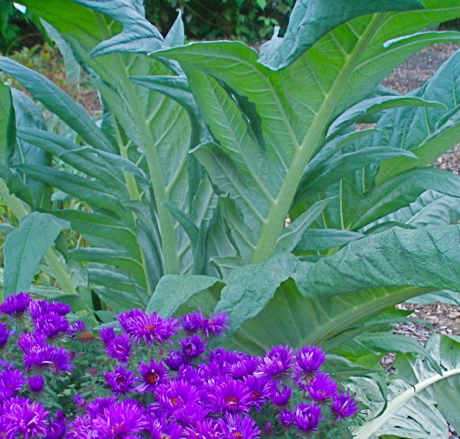
If you’re planning to grow cardoons, it’s time to start the seeds.
Please see update at end of post
We have just concluded our first contest! (Announced on February 2nd, at the end of an interview with my friend Margaret Roach about her new book, The Backyard Parables, a very Margaret melange of memoir, garden philosophy and practical garden advice.)
One winner was chosen by random drawing from the names of everyone who asked to be included. The other went to the person who was best able, in my sole judgment, to write without being cloying, predictable or religious about a happy garden experience. The Happy Story winner was chosen first, so the names of all the runners-up could be added to the random drawing list.
And the winners are:
Read More…